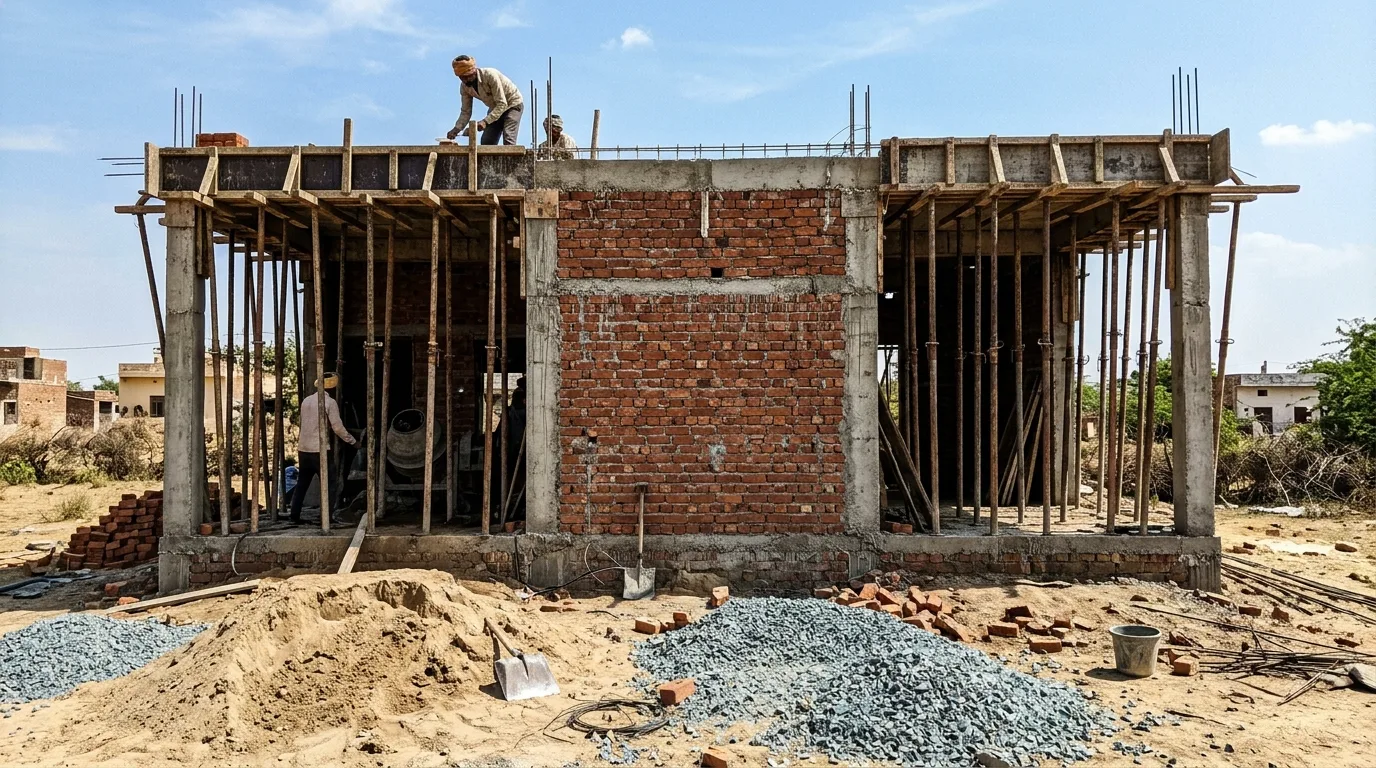
Building a permanent residence in Kota is one of the most rewarding milestones for any family. However, building in the Hadoti region comes with distinct local characteristics—from the Chambal river basin terrain to summer temperatures routinely exceeding 45°C. Without proper regional planning, homes often suffer from early hairline cracks, moisture seepage, and uncomfortable thermal gain. This guide walks you through the essential engineering stages.
1. Soil Characteristics & Foundation Design in Kota
Kota's geological profile varies widely by locality. Neighborhoods like Kunhari, Jay Shree Vihar, and Thekra Road often feature hard rock layers with excellent load-bearing capacity, while plots situated near agricultural canals, Borkhera, or river channels feature deep black cotton soil that expands during monsoon and shrinks in summer. Conducting a standard soil test (SBC test) ensures whether your home needs standard isolated footing or deep strip/raft foundations to prevent uneven settlement.
2. Kota Development Authority (KDA) & UIT Approvals
Before pouring the first batch of concrete, ensure your plot layout complies with KDA and UIT Kota building bylaws. Standard residential plots require mandatory front setbacks (typically 3 to 4.5 meters depending on road width) and rear light-and-ventilation setbacks. Factoring in rainwater harvesting shafts, structural stability certification, and permanent utility approvals early prevents expensive legal delays.
3. Climate-Responsive Architecture for Rajasthan's Summers
Designing for Kota demands passive cooling strategies that significantly cut electricity bills: placing staircases, storage, and bathrooms along the south-western walls acts as a thermal buffer against scorching afternoon sun. Incorporating deep cantilever chhajjas over windows, cavity wall construction, and a central shaded courtyard or light-well promotes cross-ventilation and keeps interiors noticeably cooler.
4. High-Grade Concrete & The Non-Negotiable Curing Window
In Kota's dry heat, moisture in fresh concrete evaporates at an accelerated rate, causing plastic shrinkage cracks and lowering compressive strength by up to 30%. For all RCC elements (foundations, columns, beams, and roof slabs), continuous water ponding or wet hessian wrapping for a minimum of 14 to 21 days is mandatory. We use tested M20/M25 design mixes and Fe-550D corrosion-resistant TMT rebars.
5. Leveraging Local Kota Stone & Quality Sourcing
Kota Stone is globally renowned for a reason: when used for ground floors, basements, corridors, and exterior patios, genuine polished or honed Kota stone remains naturally cool underfoot, resists heavy wear for decades, and requires zero maintenance. Pairing local stones with high-grade river sand (tested for silt content below 5%) gives your structure durability that synthetic imported tiles cannot match.
6. Handover, Terrace Waterproofing & Final Quality Checks
Before moving in, our engineers execute a multi-point handover audit: continuous 72-hour water ponding tests on roof terraces to guarantee zero seepage, electrical circuit earth-leakage verification, plumbing pressure audits, and window perimeter silicone sealing to keep out summer dust.